Excess & Surplus Lines Insurance
Coverage for hard-to-place business
Excess & Surplus Lines Insurance (E&S)
Excess & Surplus Lines (E&S) insurance helps businesses insure unique, high, or hard-to-place risks when the standard (“admitted”) insurance market can’t offer coverage. E&S policies are written by non-admitted carriers, which can be more flexible with forms and underwriting, but are not backed by the state guaranty fund.
Contact Us
208-593-3133

Start A Quote
What is Excess & Surplus Lines insurance?
E&S insurance is designed for businesses that can’t secure coverage through traditional admitted insurers—often because the risk is unusual, higher severity, or lacks enough historical data for standard underwriting.
E&S can apply to many property & casualty needs, including:
- General liability
- Commercial property
- Professional liability / E&O
- D&O and other management liability coverages
You may also hear it called surplus lines, excess lines, or specialty lines (terminology varies by state).
Who needs E&S coverage?
- Your business may be pushed into E&S if any of these apply:
- High-hazard operations (or unusual exposures)
- Prior claims history (multiple or severe losses)
- Emerging industries (limited underwriting data)
- Catastrophe exposure (wildfire, coastal wind, flood/quake, etc.)
- Unique events or one-off risks (special events with non-standard hazards)
- New ventures/startups with limited operating history
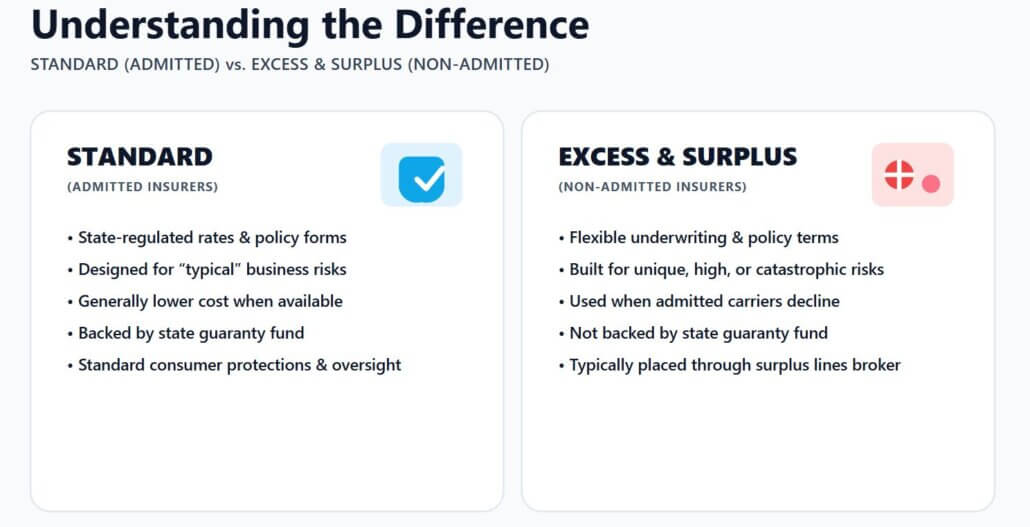
Standard (Admitted) vs. E&S (Non-Admitted): What’s the difference?
Here are the practical differences that matter to business owners:
Carrier type & regulation
Admitted carriers are licensed and regulated in the state where the policy is sold. Non-admitted carriers are typically regulated in their “home” state and can write policies across states without being licensed in every state.
Guaranty fund & consumer recourse
Because non-admitted carriers are not backed by the state, the state guaranty fund typically won’t step in if the carrier becomes insolvent, and disputes aren’t handled the same way as admitted claims.
Flexibility
E&S carriers can be more flexible on forms, terms, and pricing because they aren’t subject to the same filed-rate and filed-form requirements as admitted insurers.
Price
E&S often costs more because it’s used for higher, unusual, or catastrophe-exposed risks.